




training-behavior
<h2>Gear and Behaviour Are Connected</h2>
<p>Most people choose a collar or harness based on how it looks. That's a reasonable starting point — aesthetics matter, and your dog wears this every day. But fit and function have a direct effect on how your dog behaves on the lead, how quickly they learn, and how comfortable they are during training.</p>
<p>An ill-fitting harness that digs into the shoulder mid-walk is a distraction. A collar that applies pressure to the throat when a dog pulls teaches exactly the wrong association with the lead. Small gear decisions accumulate into habits, and habits are much harder to undo than they are to form correctly from the start.</p>
<h2>Introducing New Gear to a Puppy</h2>
<p>Puppies have no context for why a strange object is suddenly around their neck. Rushing this step creates collar-shy dogs who flinch at the sight of a lead being picked up. The desensitisation process is straightforward and takes only a few days.</p>
<ol>
<li><strong>Day 1 – Scent introduction:</strong> Leave the collar near the puppy's bed or feeding area. Let them sniff it freely with no pressure to wear it.</li>
<li><strong>Day 2 – Brief contact:</strong> Hold the collar against the puppy's neck for a few seconds while giving a treat. Remove it immediately. Repeat several times.</li>
<li><strong>Day 3 – Short wear:</strong> Fasten the collar for two to three minutes while the puppy eats or plays. Remove it before they notice it.</li>
<li><strong>Day 4 onwards:</strong> Gradually increase wear time. Most puppies stop noticing the collar entirely within a week.</li>
</ol>
<p>The same process applies to harnesses — though harnesses typically take a few extra days because they involve more body contact. Never clip a lead onto a harness on day one. Let the harness itself become familiar first.</p>
<h2>Harness vs Collar for Walks</h2>
<p>There is no universal right answer here, but there are clear guidelines depending on your dog's behaviour and build.</p>
<p>A <strong>collar</strong> is appropriate for calm, lead-trained dogs who do not pull. For these dogs, a well-fitted collar worn during walks causes no stress and provides an attachment point for ID tags at all times.</p>
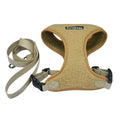
<p>A <strong>harness</strong> is generally the better choice for dogs who pull, puppies still learning lead manners, brachycephalic breeds (French Bulldogs, Pugs, Boston Terriers) whose airway can be compressed by collar pressure, and dogs with neck injuries or sensitivities.</p>
<p>A front-clip harness — where the lead attaches at the chest rather than the back — naturally redirects a pulling dog back towards you, which supports loose-lead training without any correction. Back-clip harnesses are comfortable for dogs who already walk well, but they can inadvertently encourage pulling by allowing the dog to lean into the lead without consequence.</p>
<h2>Loose-Lead Walking</h2>
<p>Loose-lead walking is one of the most commonly sought and most commonly misunderstood training goals. The objective is simple: the lead should have a natural J-curve of slack at all times, with no tension between the dog and the handler.</p>
<p>Getting there takes consistency more than technique. The core principle is that a tight lead stops the walk. Every time your dog pulls and the walk continues, the pulling is reinforced. Every time the lead goes tight and you stop, stand still, and wait for the dog to release the tension before walking again, the opposite is reinforced. This requires patience — particularly in the first few weeks — but the behaviour shifts reliably with repetition.</p>
<p>A front-clip harness supports this process by physically making it harder for the dog to generate forward momentum when pulling. It does not replace training, but it removes some of the mechanical advantage that makes pulling rewarding.</p>
<h2>On Retractable Leads</h2>
<p>Retractable leads are useful in specific contexts — large open spaces, recall training at a distance, giving a dog room to sniff and explore during a decompression walk. In these situations, they offer genuine freedom of movement.</p>
<p>They are not well suited to footpaths, busy parks, or any environment where your dog needs to be near you. The constant tension in a retractable lead actively teaches dogs to pull — the mechanism rewards forward momentum by giving more lead. For dogs still learning lead manners, a fixed-length lead is almost always the better tool.</p>
<h2>Introducing Gear to a Rescue Dog</h2>
<p>Rescue dogs often arrive with unknown histories and unpredictable responses to handling. Some have never worn a harness. Some have negative associations with specific equipment from previous experiences.</p>
<p>The same desensitisation approach used for puppies applies here — slow, low-pressure, reward-heavy. The timeline may be longer. A rescue dog who tucks and freezes when a harness is produced is communicating clearly; pushing through that response typically entrenches it. Pausing, backing up in the process, and rebuilding the association more slowly is almost always faster in the long run than forcing progress.</p>
<p>A flat collar worn loosely at home during the settling-in period — before any walk training begins — helps most rescue dogs habituate to collar contact without adding the additional pressure of an outing.</p>
<h2>PAWD's Hardware Philosophy</h2>
<p>None of PAWD's products use prong, chain, or correction-based hardware. Every collar and harness uses a standard D-ring placement that distributes lead pressure evenly and does not create a choking or tightening effect when tension is applied. This is a deliberate choice — not a fashion decision, but a functional one grounded in how dogs actually learn.</p>
<p>Gear that causes discomfort when a dog pulls does stop pulling — temporarily, and through avoidance. It does not teach the dog what to do instead. Gear that is comfortable, well-fitted, and paired with consistent handling creates the conditions for a dog to actually learn.</p>
<h2>A Note on Professional Help</h2>
<p>If lead behaviour is significantly affecting your dog's quality of life or yours, a qualified positive reinforcement trainer is worth the investment. One or two sessions with a professional who can observe your dog in real time is worth considerably more than any amount of reading. The gear supports the training; it does not replace the trainer.</p>