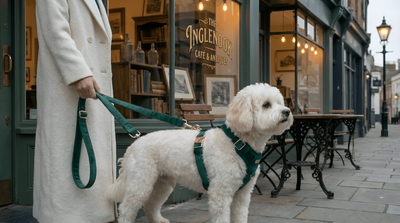
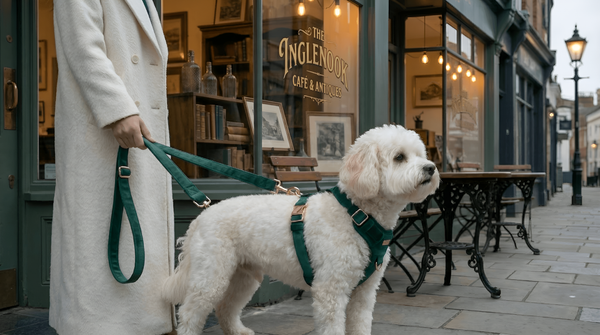
Choosing a Harness for a Nervous or Reactive Dog
An anxious or reactive dog needs different things from a harness than a confident one. The wrong choice can deepen the anxiety, or turn a tense walk into a real safety problem. This is what matters.
Nothing that tightens
A harness that constricts when your dog pulls adds pressure at the exact moment they are already overwhelmed. For a confident dog that is merely unpleasant. For a worried one, it links the frightening thing on the street to a physical squeeze, and the fear deepens rather than eases.
Choose instead a fixed-shape harness with a wide, padded chest panel that spreads any sudden load and leaves the shoulders free to move.
Two points of contact
A dual-clip harness, with a ring at the chest and another on the back, gives you far more control without any force.
The front ring turns a lunging dog back towards you rather than letting them drive forward. The back ring is for ordinary walking. For a reactive dog, a double-ended lead clipped to both at once gives a steering effect that takes the power out of a lunge without hurting anything.
Escape resistance matters more here
A frightened dog reverses. It is the most common way reactive dogs get loose, and it happens in a moment.
Look for three points of adjustment rather than two, so you can achieve a truly snug fit at the neck, the chest and the girth. The fit test for an anxious dog is closer than standard: one finger under the back panel, not two. No turning around the body, and no drawing a front leg back through.
If your dog has escaped before, a harness and a collar with the lead clipped to both is a sensible second safeguard.
Do the harness homework before you need it
Many anxious dogs come to dread the harness itself, because it only ever appears just before a walk that overwhelms them. The harness stops being a harness and becomes a warning.
So break the association. Leave it out where your dog can sniff it. Put it on at random moments indoors and then do nothing at all. Feed them dinner in it. Take it off again without going near the door. Repeat until it predicts nothing.
It takes a week or two, and it changes how your dog arrives at the front door, which changes everything that follows.
What we would point you to
A padded vest-style harness with a wide chest panel and several adjustment points. The wide panel spreads a sudden lunge across the sternum rather than concentrating it into a narrow strap, and the adjusters give the snug fit a worried dog needs.
Most of our vest harnesses are vegan leather or nylon webbing. If your dog is often out in the wet, or drools when stressed, nylon is easier to keep clean.
What gear cannot do
A harness manages a reactive dog. It does not treat the reactivity, and no harness will.
If your dog is lunging, barking or freezing on walks, what changes it is distance work with a behaviourist: keeping your dog far enough from the trigger that they can still think, then closing that distance over weeks. Good gear gives you the safety margin to do that work. It is not a shortcut past it.
Common questions
Is a head halter better for a reactive dog? The control is strong, but many dogs find halters aversive enough to add stress rather than ease it. If you use one, desensitise slowly and never pair it with a sudden jerk of the lead.
Front clip or back clip? Front, or both. A back clip on its own gives a lunging dog something solid to brace against.
My dog freezes and will not walk in a harness. That is usually the harness predicting something frightening, rather than the harness itself. Go back to wearing it indoors with food, and leave the lead in the drawer for a week.
How tight should a harness be on an escape-prone dog? One finger under the straps rather than two, and no turning around the body. Check it every time, because harnesses loosen quietly.